
Article - November 2, 2026 - 5 min read
Suvarnabhumi Airport to Your Bangkok Hotel: Choosing by Area
A practical area-by-area guide to choosing rail or a door-to-door car from Suvarnabhumi Airport, based on your exact hotel address, luggage and final connection.
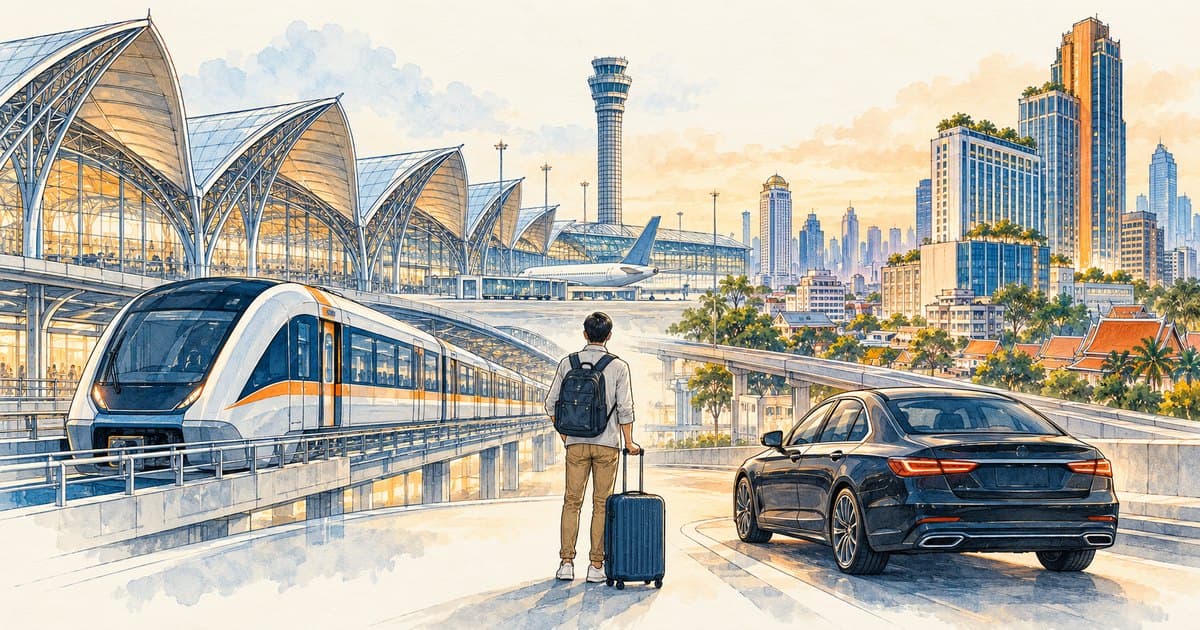
For a Suvarnabhumi Airport to Bangkok hotel transfer, rail often suits travelers with manageable luggage and a simple final connection. A door-to-door car often makes more sense for families, bulky bags, late arrivals or hotels with an awkward last leg. Check the exact hotel entrance on a map rather than choosing by a broad area name alone. The official Suvarnabhumi transport guide currently lists Airport Rail Link operating hours as 05:30–24:00, but that window should not be treated as a guaranteed departure for a particular train.
Start with the hotel pin, not the neighborhood name
A hotel marketed as “Sukhumvit,” “Riverside” or “near transit” may still be some distance from the station or route you need. For a rail journey, count every part: the Airport Rail Link, any change between systems, the correct station exit, lift availability, pavement or stairs, and the final walk or local ride.
Your bags and party matter just as much as the map. Large cases, a stroller, children, mobility needs or oversized items can turn a short-looking connection into the hardest part of the arrival. For a private car, compare the passenger count and actual luggage with the published vehicle categories and capacities. Bag size and shape affect fit, so a listed maximum is not a promise that every combination will fit together.
Hotel area | What to verify on the exact address | When rail may fit | When a door-to-door car may fit |
|---|---|---|---|
Sukhumvit | Useful station, exit, lifts and final walk or ride | Simple connection and manageable bags | Awkward last leg, bulky luggage or a group |
Silom/Sathorn | Whether the required connection is genuinely convenient | Straightforward change and short final leg | Several changes or a difficult final walk |
Riverside | Riverbank, road entrance, bridge or boat dependency | A practical onward connection to that hotel | Crossing or luggage handling adds friction |
Old Town/Khao San | Road access and onward ride from the rail network | The extra road leg is acceptable | Avoiding another transfer matters |
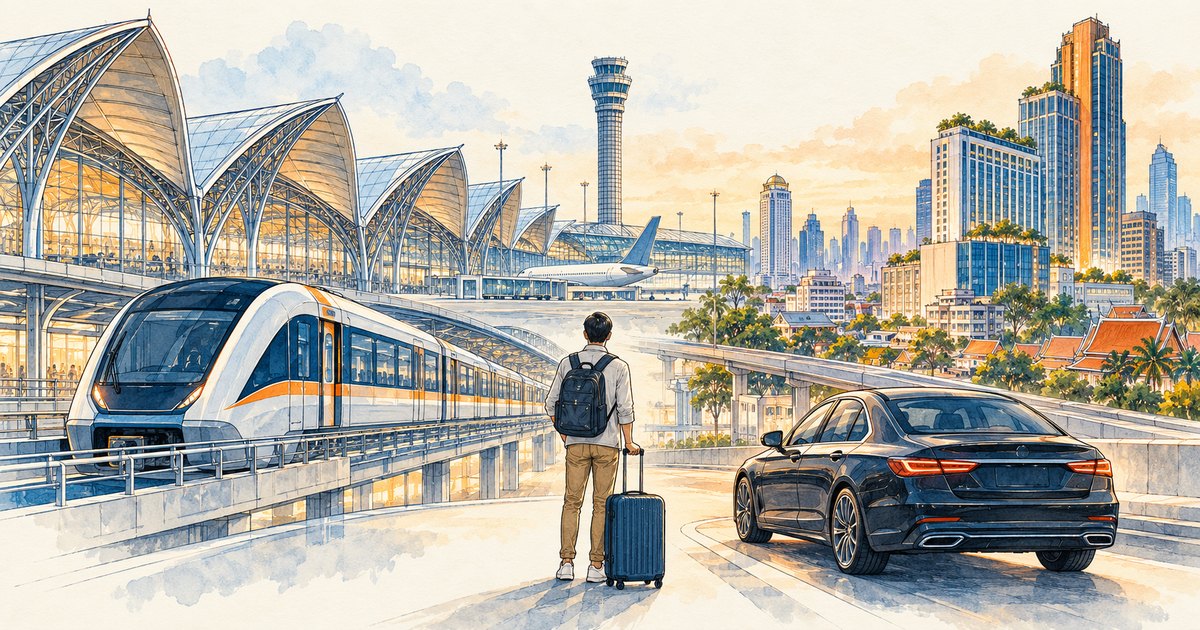
Sukhumvit: rail works when the last connection is genuinely simple
Sukhumvit is long and varied, so the district name does not identify one useful station. Phaya Thai connects the Airport Rail Link with the BTS Sukhumvit Line, while Makkasan connects with the MRT Blue Line via Phetchaburi, as outlined in the government rail overview.
These are changes between transport systems, not a direct train to your hotel. They may involve separate fares, walking between platforms or stations, and another walk or ride at the end. Inspect the route from the correct station exit to the hotel entrance, including lift access. A rail option can look neat on a network diagram while being inconvenient at street level with luggage.
Silom, Sathorn and Riverside: the final connection can decide it
For Silom or Sathorn, look beyond a hotel’s claim that it is near transit. Check how many changes the journey requires, whether those changes are practical with your bags, and how far the correct exit is from the entrance. A straightforward connection and a short final leg may favor rail; repeated changes followed by stairs or a difficult walk may favor a car.
Riverside needs another check: the exact riverbank and the hotel’s real road approach. Some addresses have a simple onward connection; others may introduce a bridge, boat or additional road ride. Do not assume every Riverside hotel has the same access. A car also remains subject to Bangkok traffic, but door-to-door service can remove the need to transfer luggage repeatedly when the last connection is complicated.
Old Town and Khao San: plan the road-based last leg
The Airport Rail Link does not go directly to Khao San Road or to a hotel door in the Old Town area. Rail can still cover part of the journey, followed by a road connection, so this is not a choice between “rail available” and “no rail.” The real question is whether you are comfortable arranging and managing that extra transfer after a flight.
If you have light luggage and do not mind the onward ride, a combined journey may work well. If the extra handoff is the part you most want to avoid, one prearranged airport-to-hotel journey may be the clearer option.

Example: the same airport, two different best choices
Consider this illustration rather than a real customer story. One traveler lands within rail operating hours with a small case. Their hotel is near a convenient exit, the route requires a simple change, and the final walk has suitable lift access. Rail may remove the hardest part of that journey.
Now consider a family carrying large cases and a stroller. Their hotel has a less convenient final connection involving another transfer and a longer street-level approach. A prebooked car may remove more friction, provided they disclose every passenger and bag and confirm a suitable vehicle category. Neither answer follows from “solo” or “family” alone: arrival time, changes, exit access, final distance and real luggage determine the better fit.
Summary
Find the exact hotel pin and entrance before choosing. Count every rail change plus the final walk or road ride, and check the correct exits, lifts and riverbank where relevant. Then factor in the luggage your group will actually carry. The better option is the one that removes the hardest part of your complete door-to-door journey—not the one that merely sounds best for the district.
If you prefer a prearranged BKK pickup, review the current meet-and-greet process and transfer service details, then submit your hotel address, arrival details, passenger count and luggage. A request is confirmed only after the team accepts it and sends confirmation, subject to vehicle and driver availability.